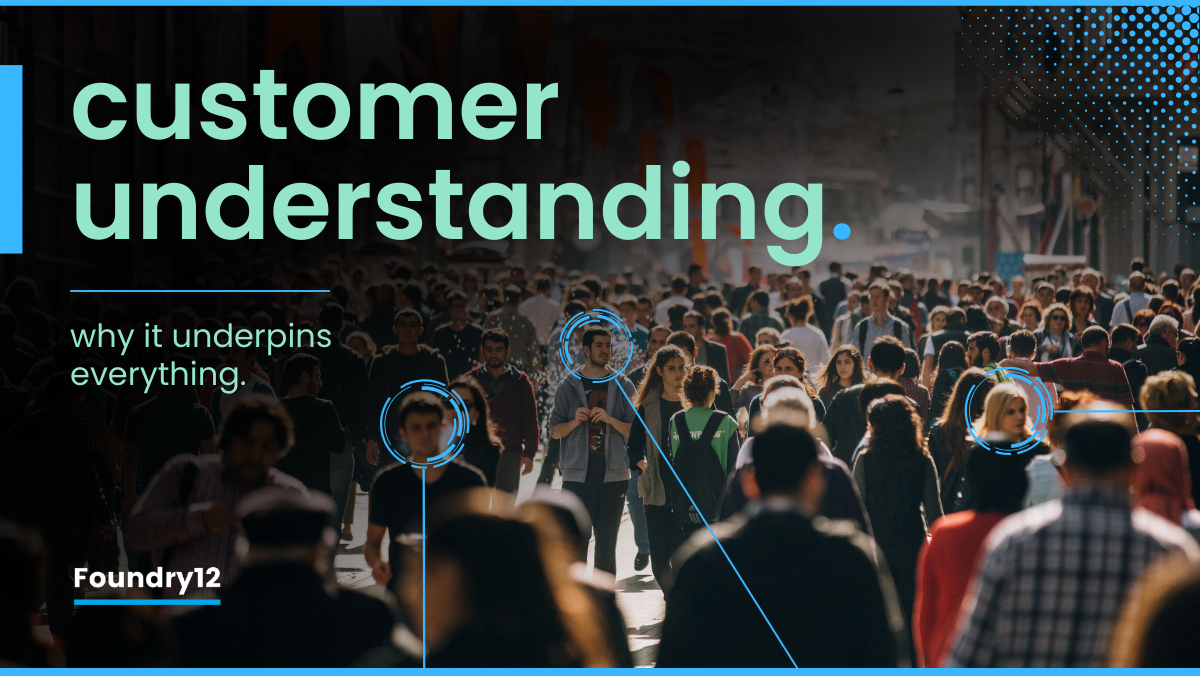
Customer understanding: Why it underpins everything
If a business is struggling to stand out from its competitors, it’s rarely down to effort. More often, it’s because they don’t understand their customers as well as they think they do. Customer understanding isn’t about having more data. Most businesses already have plenty of it. It’s about clarity – being able to clearly explain what customers are trying to achieve, what matters to them, and why they choose one brand over another.
Asking just a few simple questions quickly reveals whether that understanding is really there:
- What matters to your customers?
- Why do customers really choose you?
- What outcome are they trying to achieve?
- What are they worried about getting wrong?
- What does a ‘good’ experience look like to them?
The answers are often vague, relatively shallow and sector-generic “needs”. And that’s where problems creep in. If you don’t understand your customers better than your competitors do, selling becomes much, much harder.
Why customer understanding goes beyond data.
Most businesses define their customers by who they are: sector, size, role, demographics. That might be enough to build a list. It’s not enough to explain behaviour. It doesn’t tell you:
- what they’re really trying to achieve and the outcome they’re looking for
- what good looks like to them (and what doesn’t)
- why someone chooses you over a competitor
- why there might be hesitation, indecision, or why price suddenly becomes the battleground
And it doesn’t give you a stable foundation for targeting, positioning or messaging either. A useful test here is:
“Can you explain why customers choose you, without mentioning your products or services?”
If the answer immediately defaults to features, delivery or price, that’s a sign customer understanding isn’t deep enough. When this happens, marketing defaults to the safest option. Messaging becomes bland and blends into the sector. Websites start to feel the same. Differentiation, and any real competitive advantage, quietly disappears.
How customers really choose brands.
People don’t choose brands because of who they are “on paper”. They choose based on how well they help them meet their needs and overcome challenges.
They’re trying to get something done, make something easier, reduce risk or look good. They want to feel confident they’re making the right decision. And how they get there influences the outcome itself.
Two different customers can want the same end result, like doing the weekly shop, and still choose very different brands to help them. One values low prices and “good enough” quality (think Aldi). The other values quality, provenance and a better experience (think Waitrose). Same end result. Very different journeys.
A revealing question to ask here is:
“What would a “bad experience” look like for our customer, in their words, not ours?”
If you can’t answer that clearly, it’s hard to shape a customer experience, message or offer that feels genuinely relevant. When you miss these distinctions, you don’t have a relevant message. You blend into the category. You become a commodity.
This gets harder in B2B.
In B2B marketing, customer understanding is more complex. Buying decisions involve buyer groups with multiple stakeholders (“hidden buyers”) looking for different commercial outcomes. Finance, Procurement, IT, Ops, leadership and day-to-day users all have different priorities, pressures and definitions of success. What feels like a sensible decision to one can feel risky or frustrating to another.
Ask:
”Do different people inside our customer’s organisation define “success” differently, and do we know how?”
If you don’t understand where those perspectives diverge, you end up delivering experiences and messaging that don’t quite work for anyone.
Why customer understanding matters commercially.
Customer understanding directly affects commercial outcomes, from pricing power to growth efficiency. Which is why proper customer understanding isn’t simply a research exercise or a brand “nice to have”. It’s a commercial business advantage that:
- sharpens positioning
- clarifies messaging
- makes relevance easier to earn (and harder to steal)
- reduces the need to discount
But it also does something else often overlooked. When customer understanding is weak, business decisions become reactive. This leads to incoherent activity, inconsistent messaging, and increased commercial risk. Guesswork creeps in. And guesswork is expensive.
Strong understanding creates focus. It makes choices easier. It reduces wasted effort and lowers risk by aligning what a business does with what actually matters to customers.
That’s not just a marketing benefit. That’s a business one.
Where clarity creates advantage.
When businesses understand what genuinely matters to their customers, they stop trying to say everything. They become clearer about what they’re for, how they help, and why they’re the right choice. That clarity informs everything:
- Positioning
- Strategy
- Identity
- Messaging
Not to mention pricing and innovation.
And it leads to relevance. Growth doesn’t come from saying more. It comes from relevance: saying the right thing, to the right people, in a way that reflects what matters to them. Selling gets easier because the message does more of the work upfront.
Help with clarifying your customer understanding.
At Foundry12, we help SME’s and B2B businesses build customer understanding that strengthens positioning, clarifies messaging, and reduces commercial risk. Making them matter to those that matter to them.
If any of this has prompted a few questions, that’s usually a good place to start a conversation. No pitch. No pressure. Just a proper discussion about how customer clarity could make the biggest difference for you.
_________________________________________________________
You might also fancy reading about how brand is your company’s greatest de-risker.