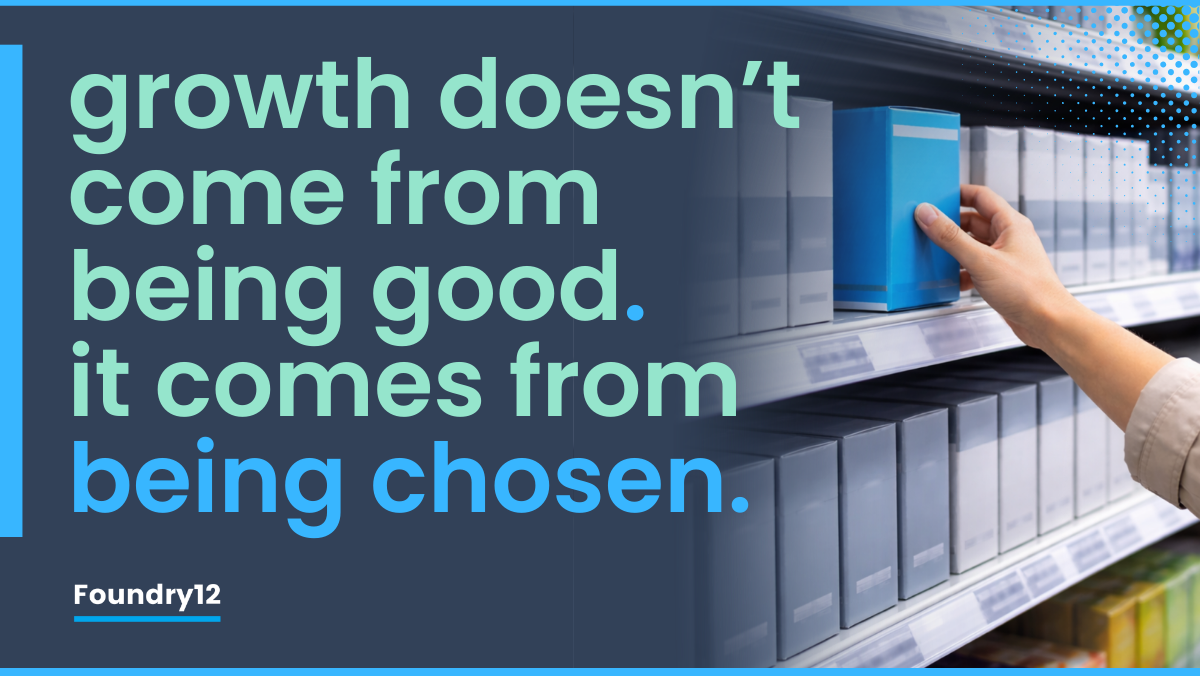
Growth comes from being chosen. Make sure your brand is easy to choose.
One of the uncomfortable realities of business is that being good at what you do isn’t necessarily enough to deliver growth.
Very often, the businesses that grow fastest aren’t simply the ones with the best product or service. They’re the ones that have made themselves easier to choose.
You can have capable people, a strong offer and a model that consistently delivers for customers. Yet still find growth harder than it should be. Opportunities take longer to convert, margins come under pressure and competitors who don’t have an obviously better offer keep winning.
When growth starts to slow, leadership asks tougher questions, and the instinct inside many organisations is to do more. More campaigns, more outreach, more tactical activity to try and stimulate demand and get the numbers moving again. It’s an understandable reaction. When revenue weakens or sales cycles become longer, pushing harder feels like the right thing to do.
But growth rarely comes from simply doing more activity.
Growth starts with a decision.
Every pound of revenue stems from buyers making a decision. They choose you or they choose someone else.
That choice involves comparing capabilities or pricing, but it’s also heavily influenced by your business’s perceived value. How clearly your message is understood. How confident the buyer feels in their decision. Whether you feel like the sensible, credible choice. One they can defend or justify.
There are plenty of very solid businesses out there that find themselves missing out on opportunities or having to work harder to secure them. Not because their offer is weaker, but because their competitors have built brands that are easier to recognise, easier to understand and easier to justify choosing.
The 95:5 rule.
Part of the reason for this is how buying actually works. In most B2B markets for example, only a small percentage of potential customers (around 5%) are actively looking to buy at any given moment. The vast majority aren’t in-market yet, which means the brands that win are the ones that come to mind first when the need eventually arises. Basically, they get on a buyers Day One shopping list.
Whether B2B or B2C, staying front of mind is all about mental availability. In everyday terms it means that when someone is in a buying situation and wants what you sell, your brand is the first option they think of.
And it’s why solid businesses sometimes lose out to better-positioned competitors. Not because the competitor delivers better products or services, but because their brand sticks in people’s memory, comes to mind when a buying occasion occurs, and makes the choice feel simpler.
Humans don’t like friction in decision-making. It slows things down and complicates matters. So if you make the decision and the choice easier, you win.
What happens when a brand becomes harder to choose.
Over time markets evolve, expectations shift and new competitors enter the category. And what customers valued five or ten years ago isn’t always exactly what they prioritise today.
Sometimes another provider:
- Communicates their value more clearly
- Makes their proposition easier to understand
- Aligns their brand more closely with what buyers want
None of this necessarily means your business has stopped delivering value. But it can mean that the centre of gravity in the market has moved slightly, and another option now feels like the more natural choice.
Have you become misaligned with how the market defines value now? Are you no longer seen as the brand that reduces risk or uncertainty better than your competitors? Is the perception that other brands satisfy customer needs better than you?
When that happens, the impact tends to show up commercially before it’s fully understood strategically:
- Fewer people choose your brand
- Customers choose it less often
- Price becomes easier to question
- Discounting creeps in to defend volume
- Marketing spend increases to maintain the same level of visibility
The business ends up working harder simply to hold its position. That’s usually when activity ramps up again. More campaigns, more sales effort, more tactical initiatives to try and boost current demand. Sometimes it helps in the short term. But if the underlying issue is that the brand is no longer as clear, distinctive or easy to choose as it once was, then more activity simply means pushing harder on the wrong lever.
The question you should ask.
The opportunity lies in taking a step back and asking the right question. Not “How do we generate more demand?” But:
“Are we still the brand people naturally choose?”
Make your brand easier to choose.
Answering that question starts with understanding how customers define value today, not how they defined it when the business first built its reputation.
If your customers have started saying “It’s fine but…”, “We’re exploring options…” or “We’re currently rethinking our approach…” it’s time to reassess your position and make yourself easier to choose again. To do that you need to clearly understand:
- What pressures are shaping their decisions?
- What problems are they really trying to solve?
- What makes one business/brand feel like the safer or smarter choice than another?
Businesses that grow more easily have a very clear view of those answers. And they shape their positioning, messaging and customer experience around them, making it straightforward for buyers to understand quickly where they fit in and why they matter.
From there the task becomes one of consistency, making sure that understanding shows up in every message, every channel and every place customers come into contact with the business.
Put simply, the job is to move from complexity to clarity. When buyers clearly understand why you matter and remember you, choosing you becomes easier.
And when choosing you becomes easier, growth follows.
If you aren’t chosen you don’t grow.
Helping businesses find their direction, sharpen their positioning and hone their messaging is exactly the kind of work we spend our time on at Foundry12. Because for most businesses the challenge isn’t capability. It’s making sure the right people understand and remember why you’re the right choice.
The question to ask yourself is: How easy is your business to understand and choose today?