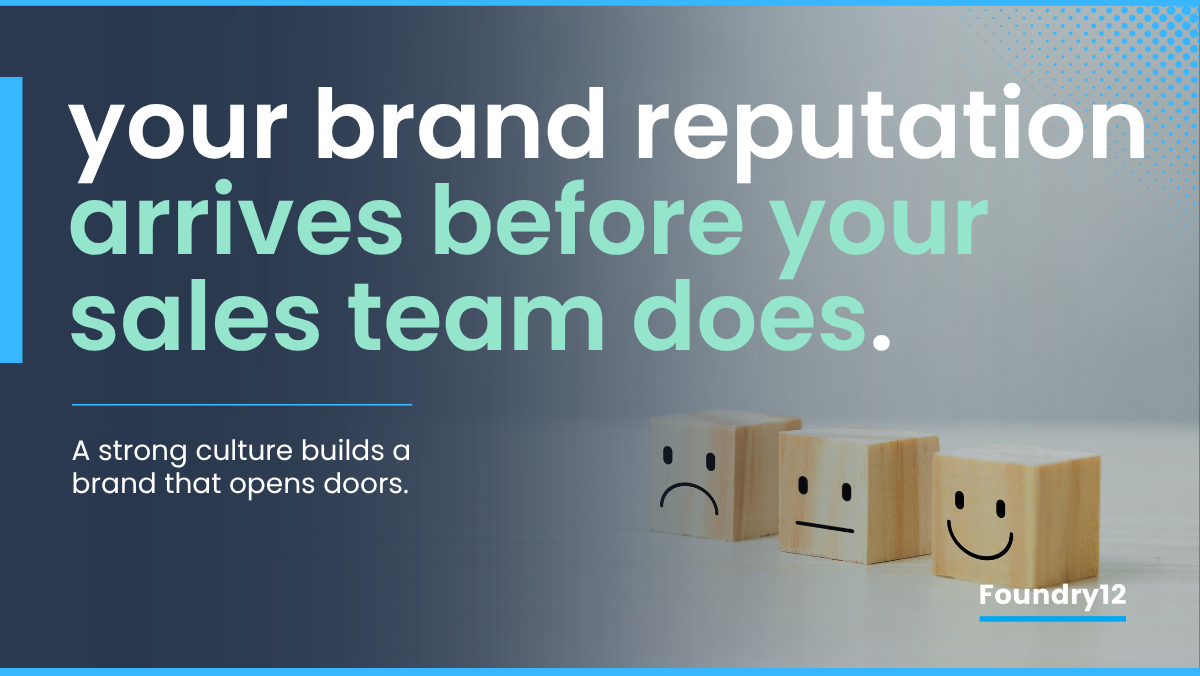
Getting your culture right builds a brand that opens doors.
Jeff Bezos is credited with saying:
“Your brand is what other people say about you when you’re not in the room.”
And if it was indeed Jeff who regaled us with that nugget, he’s right, isn’t he?
People trust their friends and their colleagues. So what they say, good or bad, when you’re not there plays a big part in whether you get remembered, recommended or shortlisted. Long before you or your sales team gets the chance to speak (if you get the chance at all).
And what they say stems from what it’s actually like to deal with you. Meaning your brand is shaped as much by your culture as by your marketing.
Every business has a culture. Yours has one right now whether anyone built it or not. It’s in how people talk to each other, what gets rewarded, what gets tolerated, and what happens when nobody’s checking. The question is, is it the culture your brand needs?
There’s a story (probably a bit of an urban legend but don’t let that stop me) that, on a visit to NASA, President Kennedy asked a janitor what he did. The janitor didn’t reply with “I make sure the toilets are clean and there’s always soap in the dispenser.” He said “I’m helping put a man on the moon.” True or not, the point’s bang on. People who can see how their role contributes to something bigger and feel valued make better choices without being told. And build a positive, strong culture.
No business should neglect or underestimate that. Because you can set rules for the situations you can predict. But when situations occur that you haven’t predicted, your culture’s what steps up. Or fails.
When sales are flying, everyone feels like a team. When things aren’t going so well, that’s when your culture gets tested and reveals itself: when you lose a big client, when a project goes pear shaped, when the easy option and the right option aren’t the same.
Everyone in your business plays their part in shaping what it’s like to deal with you. Every day, mostly in moments nobody in leadership will ever see.
So where does your brand fit in? It isn’t just your logo, your jingle, your tagline, or what you chose to say about yourself in your latest campaign. It’s what you stand for. Your vision says where you’re going. Your mission says what you do to get there. Your values say how you behave on the way. And your positioning says what you want to be known for. Together, they govern your behaviour, inform your decisions and guide your actions.
Which is why brand underpins your culture. What you stand for shapes what your people do. And what your people do shapes what everyone else says about you.
Where your brand reputation is really made.
 Think about the kind of moments a buyer actually experiences. You know, how the phone gets answered. How the proposal you’ve put together reads. How your account manager behaves when a project goes a bit sideways. How a complaint gets handled, or how an invoice gets chased.
Your marketing makes your promises. It’s everyone in the business who then keeps them or breaks them. And buyers will always believe the behaviour over the messaging. Because they’re, you know, people. Yep.
Which makes your culture a commercial issue, not just an HR one.
Turning brand into culture.
There are four things that manage to get your brand out of the guidelines PDF sitting unloved and unused in a shared drive somewhere, and into how people behave.
Make it mean something.
Values only shape behaviour if they stand for something. Commonly used, could be said by anyone values like ‘Integrity, innovation, passion’ can fail at the first hurdle: no one has ever declined a piece of work because it lacked sufficient passion. And when these phrases get bandied about by your competitors, they lose their meaning for you.
Make your values the foundations for trade-offs and choose to be one thing at the cost of being another. So you’re able to say ‘we’d rather lose the pitch than win it on lowest price.’ Or ‘we’d rather say no than overpromise.’
If your nearest competitor could adopt your vision, mission and values without anyone noticing, they’re not really your culture are they? Nor something your people can get behind.
Show everyone where they fit in.
That NASA janitor knew how his job connected man to the moon. Most people never get told how what they do contributes to the greater, shared goal. Spell it out, team by team, and everyone pulls in the same direction. What does the brand mean for how Finance chases an invoice, how Delivery handles a problem, how Sales decides which leads to walk away from?
A positioning statement means nothing to an account manager until it tells them what to do differently on a Tuesday afternoon when some stinky stuff’s hit a fan.
Hire and build a team for it.
Make your brand visible in recruitment and candidates can start self-selecting, in or out. They can see if ‘this is the place for them.’ Make sure interviewers have the values to measure against, not just the set of skills required by the role. So they can identify new team members who’ll fit into your business and make a positive contribution. Skills can be learned, values and culture have to be aligned from the outset.
Walk the walk, don’t just talk the talk.
People inside a business see the day to day with their own eyes and they have an innate ability to sense what’s real and what’s bull. They take behaviour over messaging, just as buyers do outside it.
So always explain decisions in brand terms: ‘We’re not taking this on because it isn’t who we are, and here’s why.’ Do that often enough and it becomes ingrained. The contract you walked away from becomes the story new starters hear in their first week, and it teaches them more about your culture than any workshop ever could.
Your reputation is what opens doors.
Get all that right and turn your brand into your culture, and the benefits are seen commercially.
The same brand shows up in every interaction. Your own people describe the business the same way, without a script. Customers notice and tell their colleagues.
That consistency’s the commercial bit. Buyers don’t remember brands because of one stellar campaign. They remember the ones that show up the same way, again and again, across everything they come into contact with. That includes your marketing. But it’s also your people, your proposals, your service, and what other people say about you.
Every inconsistency blurs the picture, and blurry brands don’t get remembered. When everything tells the same clear story, your brand becomes easier to recognise, easier to understand and easier to recommend. It’s what makes you come to mind when a buyer needs what you offer, and it’s what gets you onto their shortlist.
When the experience lives up to the story, you become the one they’d rather choose, not just one of the options.
Dentsu’s B2B Superpowers Index 2025, based on more than 6,000 interviews with B2B decision-makers, found the No. 1 driver of buying decisions, for the third year running, was ‘I feel safe signing a contract with them’. And the brands buyers rate highest on it stand out for three things: reputation, reach and advocacy. Two of those three are built by what it’s actually like to deal with you.
When you’re not there to wax lyrical about why your brand’s the right one, your culture is what you’ve got doing the hard yards. Get it right, and your reputation makes the introductions. Your Sales Team stops having to prise doors open and starts walking through ones already ajar.
Not sure where your brand stands?
Grab the free Foundry12 Brand Health Scorecard. Ten quick questions that show you where your brand is working for you, and where it’s quietly working against you. No sign-up needed. Once you’ve completed it, let us know how you got on. Email your score to ianbamford@foundry12.co.uk and we’ll tell you where we’d look first.
Or if you’d rather talk it through, how about a free 30-minute brand clarity call? No pitch. Just a proper conversation about where your brand might be working against you, and what to do about it. Get in touch and we’ll find a time.